
A Dark Room ®
Amir RajanRole Playing
4.71.81K Reviews
- Version
- 18.6
- Installs
- 100.00K
- Age Rating
- Everyone
Screenshots
Our Review of A Dark Room ®
 Analysis by Appyee
I find A Dark Room works best when I let it set the pace rather than treating it like a conventional role-playing game. Its spare presentation makes small changes feel important, and the mystery gives a quiet session a satisfying sense of direction. It is a paid game, so I’d want to know whether that slow, text-led style suits me before buying; for the right player, its restraint is the point, not a compromise.
A measured pace, not a spectacle
The opening is deliberately quiet. There is little explanation to skim through and no busy screen competing for attention, so progress can feel slower than in a typical role-playing game built around frequent battles, characters, and visual rewards. I would not choose it when I want instant action. I would choose it when I have a few calm minutes and want the next small discovery to give me a reason to keep going.
That makes it easy to fit around ordinary routines. I can imagine opening it during a short break, tending to the immediate needs of the camp, then returning later when I have more time to explore. The text-first design is comfortable for brief check-ins, although the suspense and gradual reveals are more satisfying when I’m not constantly interrupting myself. If I’m looking for something to play while also following a show or conversation, I may lose the thread of what I was trying to accomplish.
What longer sessions ask of you
As the settlement grows and exploration becomes part of the loop, the game asks me to think about how one activity supports another. Gathering is not simply a task to repeat: resources help the community develop, while leaving the safety of camp brings a different kind of risk and discovery. A useful habit is to pause before setting off and consider whether I have taken care of the camp’s immediate needs. That small mental check can make an expedition feel like a choice rather than an impulsive detour.
The trade-off is that some stretches are about patience and planning, not constant new plot revelations. Players who enjoy watching a system gradually open up may find that rhythm absorbing. Anyone who needs rapid combat, elaborate character builds, or a steady stream of clearly marked objectives may find the minimalism too austere. The game’s quietness is a genuine strength, but it can also make progress feel opaque if I’m expecting a conventional role-playing quest structure.
Who will enjoy its particular kind of mystery
I’d recommend it to readers who like piecing together a story from clues, and to strategy-minded players who enjoy seeing a modest camp become more consequential. It can also suit someone who wants a game that asks for imagination instead of relying on detailed visual presentation. The text leaves room to picture the cold room, the fire, and the world beyond the camp in a personal way; that is more involving for me than being shown every detail.
I’d steer away from it if I’m in the mood for a lively multiplayer session, a strongly guided story, or visually rich exploration. It is also not my first choice when I want to make progress without reading carefully. The writing is the main channel through which the world and its developments reach me, so skimming is likely to weaken the very thing that makes the experience distinctive.
How it differs from familiar role-playing games
Compared with the usual role-playing game, this one puts less emphasis on spectacle and more on what I infer from a lean stream of text and practical decisions. It is closer to an unfolding interactive mystery with resource-management elements than to a large, character-driven adventure. That comparison helps set expectations: I should not buy it hoping for cinematic scenes or a complicated inventory of equipment. I should buy it if the idea of interpreting a world while steadily tending a fragile community sounds appealing.
There is a useful middle ground here for players who find pure interactive fiction too passive but find sprawling role-playing games too demanding. Camp development gives the story a practical rhythm, while exploration prevents the experience from being only a sequence of management chores. The balance will not please everyone: if I care most about combat variety, visible character progression, or frequent action, a more traditional RPG is the better fit.
Small decisions that make play smoother
One non-obvious way to approach the game is to treat a session as having a purpose. I might focus on keeping the camp supplied, or use a longer stretch for exploration rather than switching goals every few minutes. That reduces the feeling of wandering between unrelated tasks and makes cause and effect easier to follow. It also gives me a natural stopping point when I need to put the phone down.
I would also resist trying to rush the mystery by tapping through every line. The sparse presentation can make each passage seem brief, but the details are doing much of the storytelling work. Reading with attention is a practical advantage, not just a literary preference: it helps me understand why the current situation matters and gives later discoveries more weight. The game’s restraint rewards patience more than frantic input.
Reliability and everyday performance
Because the experience is built around text and simple presentation, I would expect it to feel less visually demanding than a graphics-heavy role-playing game. That is an expectation based on its design, not a promise about how it behaves on every device. The core appeal does not depend on elaborate animation or a crowded action scene, so it should be a sensible kind of game to consider for a modest play session when I want a quieter alternative.
My practical advice is to keep the device’s operating-system requirement in mind before buying: the game requires version 8.0 or later. The current release is version 18.6, and the developer is Amir Rajan. If I am choosing between devices, I would prioritize a screen where reading feels comfortable over raw gaming power. Text is the central interface, so a cramped display or frequent interruptions can affect enjoyment more directly than a lack of graphical horsepower.
For reliability, I would judge the experience by whether I can settle into a session without expecting flashy effects or rapid visual feedback. The minimalist approach lowers the kind of performance demands I associate with large action games, but it does not justify claims about battery use, loading time, or flawless stability. If I rely on a particular older device, checking that it meets the operating-system requirement is the sensible first step; after that, the game’s readable, low-key style is its clearest practical advantage.
Unveiling the Mystery
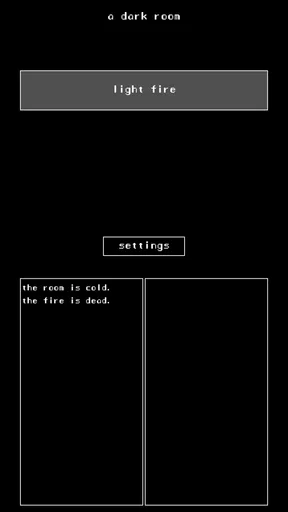
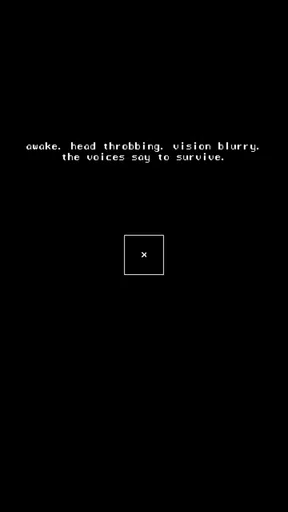
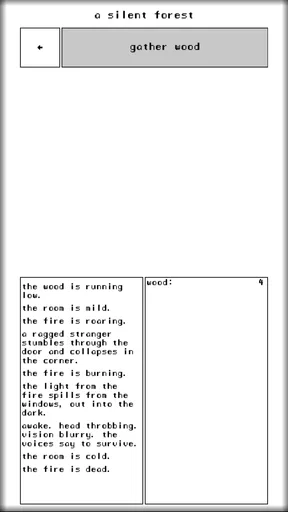
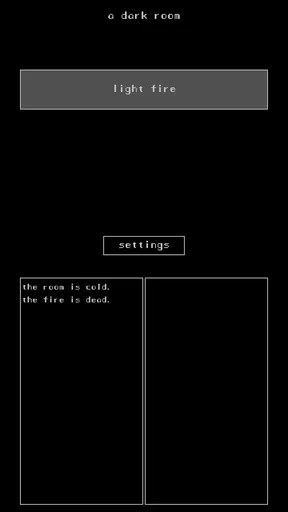
First off, A Dark Room doesn’t give you much to go on at the start. You awaken in a cold, dark room with little context. But that’s the beauty of it, right? It’s like reading a mystery novel where you’re not just a spectator but the main character. The game slowly reveals its secrets as you progress, and the story unfolds through text, keeping you glued to your screen.
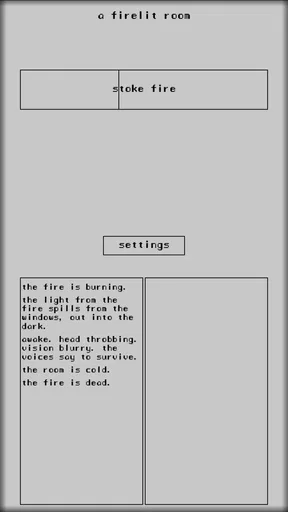
The interface is stark and unembellished, which might seem off-putting at first. But trust me, the simplicity is part of its charm. It forces you to focus on the narrative and your choices, making every decision feel significant. You’ll find yourself collecting resources, making strategic choices, and slowly unraveling the enigmatic storyline.
Gameplay Mechanics
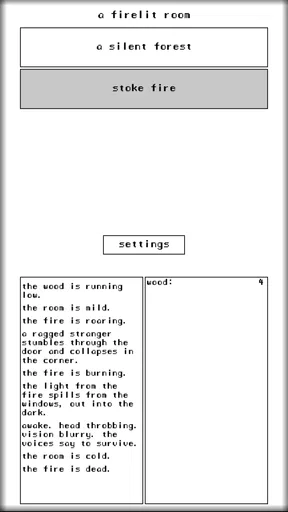
Don’t let the simplicity fool you. There’s a lot going on beneath the surface. You start by stoking a fire, which sounds mundane, but it soon becomes clear that every action has a ripple effect. As you gather resources like wood and meat, the world around you expands. Villagers arrive, and you begin to build and manage a community. It’s a subtle blend of resource management and storytelling.
The game is all about exploration and discovery. As you venture out from the safety of your campfire, you’ll explore a world that’s both dangerous and intriguing. There are wild animals, mysterious ruins, and hidden treasures to discover. It’s a bit like peeling an onion; the more you explore, the more layers are revealed.
The Storyline
Now, I won’t spoil anything for you, but the storyline is where A Dark Room really shines. It’s a narrative-driven adventure that slowly builds tension and intrigue. Each piece of text adds to the mystery, leaving you eager to see what’s next. The game explores themes of survival, community, and the human condition, all wrapped up in a narrative that’s as thought-provoking as it is engaging.
What’s fascinating is how the story subtly shifts based on your decisions. Your choices shape the narrative, making you feel like an integral part of the unfolding drama. It’s this level of immersion that sets A Dark Room apart from other text-based games.
The Experience
Playing A Dark Room is a bit like stepping into an alternate reality. The absence of flashy graphics or sound might seem like a downside, but it’s actually a strength. It forces you to engage your imagination, filling in the details of this mysterious world. And trust me, your imagination can conjure up some pretty vivid scenarios!
I found myself completely absorbed, constantly strategizing to keep my community thriving while uncovering the secrets hidden in the darkness. It’s a game that’s easy to pick up but hard to put down. You’ll find yourself sneaking in a few extra minutes of gameplay whenever you can.
Worth the paid download?
The game costs $1.99, so I’d think of it as a small, one-time purchase for a focused experience rather than an endless free-to-play routine. It has a 4.7 average from around 9.9K ratings, with roughly 1.8K written reviews and over 100K installs. Those figures suggest that many players have found its unusual approach worthwhile, but they cannot tell me whether I personally enjoy reading-led play; the best test is whether its premise sounds appealing to me.
It is rated Everyone, which makes it broadly approachable by age, though that does not mean its measured pace will suit every player. The key purchase question is less about difficulty or spectacle and more about taste: am I happy to read, infer, and let a mystery unfold gradually? If yes, the price feels easier to justify. If I want a game that immediately explains its systems and keeps presenting new visual rewards, I would spend my money elsewhere.
Where it fits in a day
A realistic use case is a quiet evening when I have a little time between chores. I can check the camp, make a considered choice, and leave the larger expedition for a stretch when I can pay attention. On a commute or in a waiting room, the text-based format is a welcome contrast to games that demand quick reactions, but I would still avoid starting a tense exploration moment if I know I may need to stop abruptly.
That distinction answers a common practical question: is it suited to short sessions? It can be, especially when I choose a simple camp task, but the story benefits from continuity. For a longer session, I can follow the thread of exploration and give the discoveries space to land. It is flexible in rhythm, not necessarily a game I would treat as disposable background.
What to expect from the interface
The interface’s plainness is part of the design, but it asks me to bring attention rather than relying on visual cues to explain everything. That is a good fit for readers who like imagining what lies beyond the words. It is less comfortable if I depend on animated feedback or need a constantly visible map of goals. I would approach the early sections with curiosity instead of assuming that a quiet screen means nothing is happening.
For a first playthrough, I would let the game reveal its structure at its own pace rather than searching for a guide immediately. Looking up explanations too soon risks flattening the uncertainty that gives the opening its pull. If I do get stuck, I would first reread the available text and reconsider what my current resources make possible; that keeps discovery intact while giving me a practical way to think through the next move.
Final Thoughts
So, if you’re in the mood for a game that challenges your mind and engages your imagination, give A Dark Room a try. It’s a unique blend of storytelling and strategy that’s both challenging and rewarding. Whether you’re a fan of text-based adventures or new to the genre, this game offers an experience that’s both familiar and refreshingly original.
And there you have it! A mysterious journey awaits in A Dark Room. Don’t just take my word for it—dive in and discover the intrigue for yourself. Who knows what secrets you’ll uncover?
My performance verdict
My overall impression is that this is a good fit for someone who wants a low-key, text-centered role-playing experience, not a test of a phone’s graphics capabilities. Its strongest practical quality is how little visual noise stands between me and the decisions, while its biggest everyday limitation is the need to read attentively and tolerate a gradual build. The game has reached 100K+ installs, but popularity alone should not settle the choice; its distinctive pace is what matters.
If I were recommending it to a friend, I’d say to buy it for the atmosphere, careful resource decisions, and slow-burn discovery, and to skip it if they want high-speed action or a heavily guided adventure. The $1.99 price is straightforward, the Everyone age rating is clear, and the operating-system requirement gives an easy compatibility check. Once those practical points are covered, the decision comes down to whether a quiet mystery sounds like a good way to spend time.
Verdict
Strengths of A Dark Room ®
- Engaging minimalist design.
- Challenging and immersive gameplay.
- Offline play available.
- Unique storytelling approach.
- No in-app purchases.
Limitations of A Dark Room ®
- Limited graphics appeal.
- May be too slow-paced for some.
- No multiplayer options.
- Lacks tutorials for beginners.
- Requires patience and strategy.
Similar Picks in This Category
View All
Hair Dye
CrazyLabs LTD4.4

Monster High™ Beauty Salon
CrazyLabs LTD4.5

Bus Simulator - Bus Games 3D
Jima Apps4.4

Flight Pilot: 3D Simulator
Wildlife Studios4.1


Super Stylist Fashion Makeover
CrazyLabs LTD4.4
Frequently Asked Questions
What is the main gameplay of A Dark Room?
A Dark Room is an intriguing text-based adventure game that combines elements of resource management, exploration, and mystery. The game begins with you stoking a fire in a dark room, and as you progress, you gather resources, build structures, and unravel a mysterious narrative. It’s a minimalist game that encourages imagination and strategic thinking.
Is A Dark Room suitable for all ages?
A Dark Room is generally suitable for older children and adults due to its complex themes and strategic elements. The minimalist text-based nature might not appeal to younger audiences who prefer more visually stimulating games. Parental guidance is recommended to determine if the themes and gameplay are appropriate for your child.
Does A Dark Room require an internet connection to play?
No, A Dark Room does not require an internet connection to play. It is designed to be a single-player offline experience, allowing you to immerse yourself fully in its mysterious world without needing Wi-Fi or mobile data. This makes it ideal for playing in areas with limited connectivity.
Are there any in-app purchases or ads in A Dark Room?
A Dark Room is a premium app, meaning there are no in-app purchases or advertisements. Once you purchase the game, you have access to the full experience without interruptions, making it a great choice for those who prefer ad-free gaming sessions without additional costs.
How long does it take to complete A Dark Room?
The length of time to complete A Dark Room can vary based on your pace and exploration style. On average, players may spend anywhere from 3 to 5 hours to finish the game. However, its open-ended nature allows for different paths and strategies, potentially extending replay value.
Play our best games!


